
Introduction
A Kids Electric Toy can turn an ordinary afternoon into an exciting adventure. Whether it is a ride-on car, electric bike, scooter, jeep or another battery-powered vehicle, children enjoy the feeling of controlling their own little ride.
However, excitement should always come after safety.
Before allowing a child to ride, parents should take a few minutes to inspect the toy and make sure everything is working properly. A quick check can help identify loose parts, damaged wheels, battery issues, steering problems or other concerns before play begins.
The good news is that these checks do not need to be complicated. With a simple routine, parents can make safety inspections a normal part of using a Kids Electric Toy.
Here are eight important checks to perform before every new toy is used and whenever there is a reason to suspect damage or a problem.
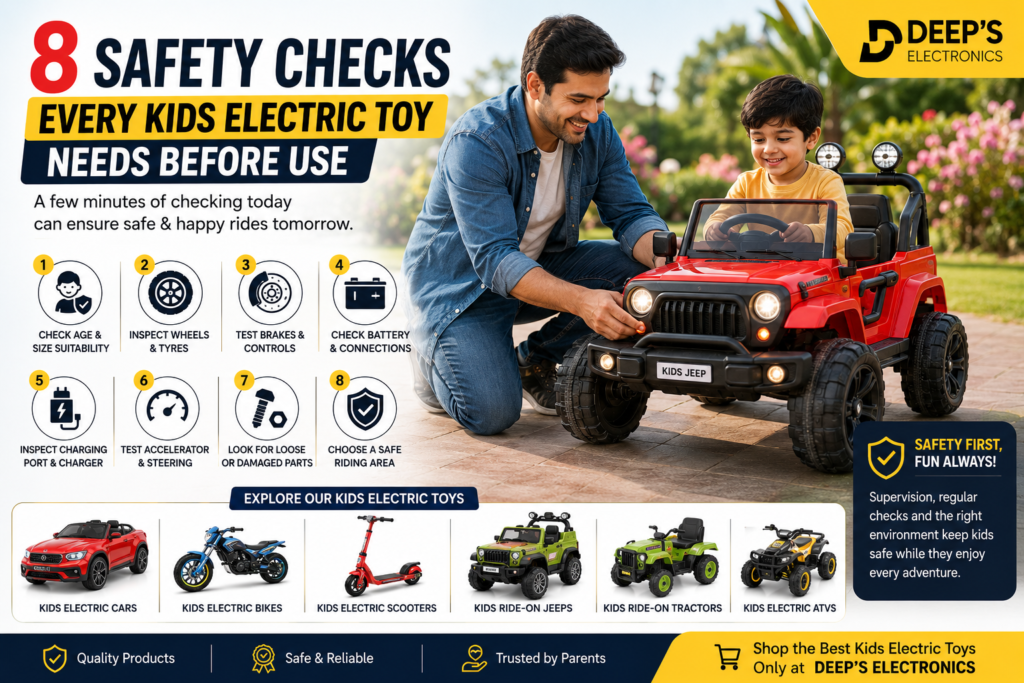
TABLE OF CONTENTS
- Why Safety Checks Matter Before Using a Kids Electric Toy
- 8 Safety Checks Every Parent Should Perform
- Check Age and Size Suitability
- Inspect the Wheels and Tyres
- Test the Brakes and Movement Controls
- Check the Battery and Connections
- Inspect the Charging Port and Charger
- Test the Accelerator and Steering
- Look for Loose or Damaged Parts
- Choose a Safe Riding Area
- A Simple Pre-Ride Safety Checklist
- Common Mistakes Parents Should Avoid
- How DEEP’S ELECTRONICS Helps Parents Choose Better
- FAQs
- Conclusion
1. Check Age and Size Suitability
The first safety check is not mechanical—it is about choosing the right toy for the child.
Every ride-on vehicle should be appropriate for the child’s age, size, abilities and the manufacturer’s stated recommendations. A toy that is too large or difficult for a child to control can make riding unnecessarily challenging.
Before purchase or use, parents should consider:
- Recommended age range
- Child’s height and size
- Seating position
- Ease of reaching controls
- Ability to understand basic instructions
- Whether the child can comfortably get on and off
Do not choose a vehicle simply because it looks impressive. The best Kids Electric Toy is one the child can use comfortably and responsibly.
2. Inspect the Wheels and Tyres
Wheels receive constant contact with the ground, so they deserve a quick inspection before riding.
Look around each wheel and check whether:
- The wheel appears securely attached
- There are visible cracks or damage
- The tyre or wheel surface looks unusually worn
- Anything is stuck around the wheel
- The wheel moves abnormally when checked
For ride-on cars and larger electric vehicles, also look at the overall balance of the toy. If something appears loose, damaged or unstable, do not allow the child to ride until the issue has been properly addressed.
A thirty-second wheel inspection can become one of the easiest safety habits for families.
3. Test the Brakes and Movement Controls
Parents should understand how the toy starts, stops and changes direction before handing the controls to a child.
Depending on the type of vehicle, check the available stopping mechanism and movement controls. Make sure the vehicle responds normally and does not continue moving unexpectedly.
If the model includes a parental remote control, parents should also understand how its controls work before the child’s first ride.
A useful approach is to perform a short test without the child sitting inside or on the vehicle. This allows you to observe the basic response without putting the child at unnecessary risk.
4. Check the Battery and Connections
The battery is one of the most important components of a battery-powered ride-on vehicle.
Before using a Kids Electric Toy, visually inspect the battery area and accessible connections. Look for anything unusual, such as:
- Loose connections
- Damaged wires
- Exposed wiring
- Signs of physical damage
- Unusual swelling or leakage
- Loose battery covers
Never ignore visible battery damage.
Parents should also follow the manufacturer’s instructions for charging, storage and battery care. Do not modify the battery or electrical system yourself unless you are qualified to do so.
5. Inspect the Charging Port and Charger
Charging equipment deserves just as much attention as the toy itself.
Before connecting the charger, check the cable, plug and charging connection for visible damage. Avoid using equipment with damaged wires, broken plugs or signs of overheating.
Parents should also:
- Use the recommended charger
- Follow the manufacturer’s charging instructions
- Keep charging equipment away from water
- Avoid covering the charging equipment while in use
- Disconnect the charger according to the manufacturer’s instructions
Charging should be treated as part of the toy’s safety routine rather than an afterthought.
6. Test the Accelerator and Steering
Steering and acceleration directly affect how a child controls the vehicle.
Before the first ride, parents should check whether the steering mechanism moves normally and whether the accelerator or movement control responds as expected.
Pay attention to anything unusual:
| Area | What to Check |
|---|---|
| Steering | Smooth and predictable movement |
| Accelerator | Normal response |
| Direction control | Correct forward/reverse response |
| Handlebar/wheel | Secure attachment |
| Controls | No visible damage |
If a control feels stuck, unusually loose or unpredictable, stop using the toy until it has been checked.
For younger children, parents should explain the controls clearly before allowing independent riding.
7. Look for Loose or Damaged Parts
A Kids Electric Toy contains multiple physical components, including seats, handles, body panels, wheels and fasteners.
Before riding, take a quick look over the complete vehicle.
Check for:
- Loose screws or fasteners
- Broken plastic
- Sharp or exposed edges
- Loose seats
- Damaged body parts
- Missing covers
- Unusual rattling
This inspection is particularly important after the toy has been transported, stored for a long period or used frequently.
If something does not look right, it is better to investigate before the next ride rather than assuming it will be fine.
8. Choose a Safe Riding Area
Even a properly maintained Kids Electric Toy needs an appropriate environment.
For younger children especially, choose a controlled riding area away from traffic, deep water, stairs and other obvious hazards.
A suitable area should provide:
- Plenty of open space
- A stable riding surface
- Good visibility for parents
- Distance from vehicles
- No steep drops or stairs
- Minimal obstacles
Parents should supervise children according to their age, ability and the manufacturer’s guidance. A safe toy and a safe environment work together.
A Simple Pre-Ride Safety Checklist
Parents can save this simple checklist and use it before riding:
| Safety Check | Done? |
|---|---|
| Age and size suitability checked | ☐ |
| Wheels inspected | ☐ |
| Steering tested | ☐ |
| Movement controls checked | ☐ |
| Battery and wiring visually inspected | ☐ |
| Charger and charging port checked | ☐ |
| Loose or damaged parts checked | ☐ |
| Safe riding area selected | ☐ |
It takes only a few moments, but it can make responsible toy use much easier.
Common Mistakes Parents Should Avoid
Safety problems do not always happen because a toy is defective. Sometimes they happen because basic instructions are overlooked.
Avoid these common mistakes:
Ignoring the manufacturer’s instructions
Every model can have different operating, charging and maintenance instructions. Read the supplied information before use.
Allowing unsuitable riding conditions
Avoid using a ride-on toy in areas where traffic, water, steep slopes or other hazards create unnecessary risks.
Continuing to use damaged equipment
If you notice damaged wiring, a cracked component, unusual movement or another concerning issue, stop using the toy until it has been checked.
Treating charging casually
Use the recommended charging equipment and follow the manufacturer’s instructions rather than experimenting with chargers or electrical modifications.
Forgetting supervision
Children may become excited and focus more on fun than surroundings. Appropriate parental supervision remains important.
Choosing a Safer Kids Electric Toy
Safety begins before the toy reaches your home.
When shopping for a Kids Electric Toy, parents should look beyond appearance and consider the overall design, controls, construction, suitability and available safety guidance.
At DEEP’S ELECTRONICS, the focus is on helping customers explore relevant kids’ ride-on products while making informed purchasing decisions. Depending on the available range, parents can explore categories such as Kids Electric Cars, Kids Electric Bikes, Kids Electric Scooters and Kids Ride-On Jeeps.
The right choice should be based on the child’s needs rather than simply choosing the biggest or most feature-packed model.
For website navigation, useful internal links can include:
- Kids Electric Toys
- Kids Electric Cars
- Kids Electric Bikes
- Kids Electric Scooters
- Kids Ride-On Jeeps
These categories can help parents compare different types of ride-on toys before making a decision.
Why Regular Safety Checks Matter
A pre-ride inspection is not something parents need to overcomplicate.
Think of it like checking a bicycle before a family ride. You look at the important parts, make sure everything appears normal and then decide whether it is ready to use.
For a Kids Electric Toy, the routine can become as simple as:
Look → Test → Confirm → Ride
Look for visible problems.
Test the important controls.
Confirm the riding area is suitable.
Then allow the child to ride according to the manufacturer’s instructions.
Regular checks are especially useful as children use their ride-on toys repeatedly. Toys can experience normal wear over time, so parents should remain alert to changes in condition.
FAQ
1. What should I check before using a Kids Electric Toy?
Check the child’s suitability, wheels, steering, movement controls, battery area, charger, physical components and riding environment before use.
2. Should parents inspect the battery before every ride?
A quick visual inspection is a good habit. Look for visible damage, loose connections or other unusual signs, and follow the manufacturer’s battery instructions.
3. Can children use electric ride-on toys without supervision?
Supervision should be based on the child’s age, ability, the specific toy and the manufacturer’s guidance. Parents should always assess the riding environment carefully.
4. What should I do if the toy has damaged wiring?
Stop using the toy and follow the manufacturer’s guidance for inspection or repair. Do not attempt unsafe electrical modifications.
5. Is the charger important for toy safety?
Yes. Use the charger recommended for the particular toy and follow the manufacturer’s charging instructions. Do not use visibly damaged charging equipment.
6. Where should children ride electric toys?
Choose a controlled area away from traffic, stairs, deep water and other hazards. The child should have enough open space to operate the toy safely.
7. How can I choose the right ride-on toy?
Consider the child’s age, size, ability, the toy’s intended use, controls and manufacturer’s recommendations. Choose suitability and safe operation over appearance alone.
CONCLUSION
A Kids Electric Toy can provide hours of enjoyable play, but responsible use starts before the first ride. Checking the wheels, controls, battery, charger, physical condition and riding environment gives parents a simple way to build safer play habits.
The most important rule is simple: if something looks damaged, feels unusual or does not work as expected, stop and check it before riding.
With the right toy, appropriate supervision and a quick pre-ride safety routine, children can enjoy their ride-on adventures while parents have greater confidence in the setup.
CTA
Looking for a Kids Electric Toy for your child? Explore the Kids Electric Toys collection at DEEP’S ELECTRONICS and compare suitable ride-on options based on age, size, controls, design and play style.
Kids Electric Toy safety, electric ride-on toy safety, battery operated toys, kids ride-on toys, electric toy safety checks, kids electric vehicle safety, ride-on car safety