
TABLE OF CONTENTS
- Introduction
- Electric vs Manual Ride-On Cars: The Basic Difference
- Electric vs Manual Ride-On Car at a Glance
- How Electric Ride-On Cars Work
- How Manual Ride-On Cars Work
- Which One Gives Children More Independence?
- Which Option Is Better for Different Play Styles?
- Space and Outdoor Use
- Supervision and Safety Considerations
- Maintenance and Everyday Care
- What Parents Should Consider Before Buying
- Which Type Fits Your Child?
- Choosing a Ride-On Car from DEEP’S ELECTRONICS
- FAQs
- Conclusion
- CTA
Introduction
Choosing a ride-on toy for a child sounds simple until parents discover how many different options are available. Some children love the excitement of a battery-powered vehicle, while others may enjoy the simple experience of moving a toy car themselves.
That is where the Electric vs manual ride-on car comparison becomes useful.
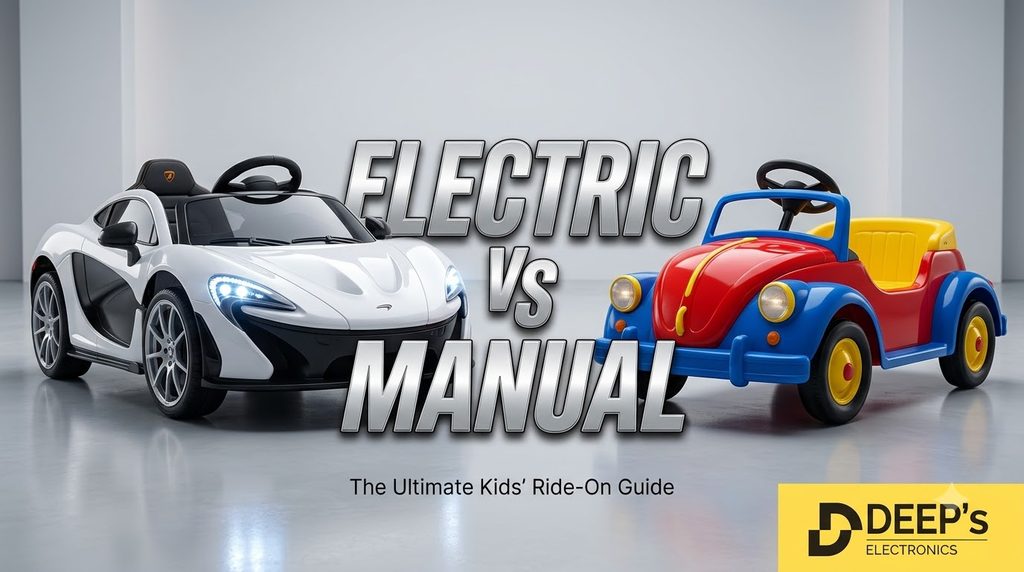
Both types can provide active play and imaginative driving experiences, but they create a different style of play. An electric ride-on car uses a motor and battery to provide powered movement, while a manual ride-on car relies on the child’s physical effort or movement.
So, which one should parents choose?
The answer depends less on which type sounds more advanced and more on the child’s age, confidence, available play space, supervision, preferred activities and the experience parents want the toy to provide.
In this guide, we’ll break down the Electric vs manual ride-on car difference so you can make a more informed decision for your child.
Electric vs Manual Ride-On Cars: The Basic Difference
The easiest way to understand the Electric vs manual ride-on car debate is to look at how each toy moves.
An electric ride-on car contains a motor powered by a rechargeable battery. Depending on the specific product, controls may allow the child to operate the vehicle, while some models can also offer parental control features.
A manual ride-on car does not depend on an electric motor for movement. The child typically moves the vehicle using their feet or physical effort.
This creates two different play experiences.
Electric ride-on car: powered movement and a more vehicle-like experience.
Manual ride-on car: physical movement and a simpler, child-powered experience.
Neither description alone tells you which option will suit your child better. The important question is how your child will use the toy.
Electric vs Manual Ride-On Car at a Glance
Before going into the details, here’s a simple comparison.
| Feature | Electric Ride-On Car | Manual Ride-On Car |
|---|---|---|
| Movement | Battery-powered motor | Child-powered movement |
| Physical effort | Generally lower during movement | More physical effort |
| Driving experience | More vehicle-like | Simple and interactive |
| Charging | Required | Not required |
| Controls | Product-dependent | Usually simpler |
| Maintenance | Battery and mechanical care may be required | Generally simpler |
| Play style | Independent vehicle-style play | Active physical play |
| Supervision | Still important | Still important |
| Outdoor suitability | Depends on product and surface | Depends on product and surface |
The exact features vary between individual ride-on toys, so always check the manufacturer’s specifications before buying.
How Electric Ride-On Cars Work
Electric ride-on cars are designed to reproduce some of the experience of driving a small vehicle.
A rechargeable battery supplies power to an electric motor. Controls on the toy can allow movement, steering and other functions depending on the model.
For children, this can make pretend play feel more immersive.
They can imagine going on a family road trip, driving to a destination, exploring the garden or pretending to operate their own little vehicle.
When discussing Electric vs manual ride-on car, this is one of the biggest differences: an electric model introduces powered movement into the play experience.
However, powered movement also means parents need to pay attention to charging, storage, operating instructions and the environment where the toy is used.
How Manual Ride-On Cars Work
Manual ride-on cars take a much simpler approach.
Instead of relying on a motor, the child uses their own physical movement to propel the toy.
For some children, this can make the play experience more active. The child has to coordinate movement with steering and positioning.
Manual ride-on toys can also be appealing to parents who prefer a straightforward toy without charging requirements.
This doesn’t mean manual ride-on cars are automatically better for every child. It simply means that they offer a different type of interaction.
And that difference is central to the Electric vs manual ride-on car decision.
Which One Gives Children More Independence?
This depends on what you mean by independence.
An electric ride-on car can allow a child to move around without physically pushing the toy along. For a child who enjoys pretending to drive, that can create a strong sense of independent play.
A manual ride-on car offers another kind of independence because the child physically controls the movement of the toy.
For younger children, parents should consider whether the child can understand and follow the operating instructions of an electric model.
For manual models, the question becomes whether the child has enough coordination and physical ability to move and steer the toy comfortably.
Therefore, when comparing an Electric car vs manual ride-on car, consider your child’s current abilities rather than choosing based only on age.
Which Option Is Better for Different Play Styles?
Every child plays differently.
For Children Who Love Pretend Driving
An electric ride-on car may create a more realistic driving-style experience.
Children can incorporate steering, movement and vehicle sounds or other product features into imaginative games, depending on the model.
For Children Who Prefer Active Play
A manual ride-on toy can encourage the child to physically move the vehicle.
The play itself becomes part of the physical activity.
For Children Who Enjoy Exploring
An electric model may appeal to children who enjoy moving around a suitable outdoor area while pretending to drive.
For Simple Everyday Play
Manual ride-ons can be attractive when parents want a straightforward toy without charging or battery management.
This is why there isn’t a universal winner in the Electric vs manual ride-on car comparison. The better fit depends on the child and the intended use.
Space and Outdoor Use
The space available at home is another factor that parents sometimes overlook.
Before buying an electric ride-on car, consider where your child will actually use it.
A suitable area should provide enough room for movement and should be appropriate for the particular product.
Look at:
- Available floor space
- Surface condition
- Obstacles
- Steps or slopes
- Garden or outdoor layout
- Areas where adults can supervise
Manual ride-ons also require suitable space, even though their movement works differently.
If your home has limited room, think about whether the toy can be comfortably stored and used.
The Electric vs manual ride-on car choice should therefore consider not just the toy but also the environment in which it will be played with.
Supervision and Safety Considerations
Regardless of which type you choose, supervision remains important.
An electric ride-on car can move under motor power, so parents should understand the controls before allowing a child to use it.
For a manual ride-on car, parents should also make sure the child has a safe area in which to move.
A few basic habits can make ride-on play more responsible:
- Read the product instructions before first use.
- Follow the manufacturer’s recommended age and usage guidance.
- Use the toy only in an appropriate area.
- Keep children away from traffic and other hazards.
- Check the toy regularly for visible damage.
- Make sure charging is performed according to the manufacturer’s instructions for electric models.
- Supervise younger children during play.
When considering Electric vs manual ride-on car, safety should be treated as a separate consideration rather than assuming that one category is automatically safe in every situation.
Maintenance and Everyday Care
Maintenance is another practical difference.
Electric ride-on cars contain electrical and mechanical components, including a rechargeable battery. Parents should follow the manufacturer’s guidance for charging, storage and care.
The battery should be handled according to the instructions supplied with the particular product.
Manual ride-on cars generally have fewer electrical components because movement does not depend on a motor and battery.
However, both types still deserve regular inspection.
Check the wheels, steering, body, controls and other visible components periodically.
Keeping the toy clean and storing it appropriately can also help maintain its condition.
This is another reason why the Electric vs manual ride-on car decision should include long-term care rather than focusing only on the initial purchase.
What Parents Should Consider Before Buying
Instead of asking, “Which ride-on car is better?” ask these questions.
How Old Is My Child?
Start with the manufacturer’s recommended age range.
Age recommendations exist because children at different developmental stages can have different abilities and requirements.
Where Will the Toy Be Used?
Indoor play, gardens and outdoor spaces can create different requirements.
How Much Supervision Is Available?
Think about whether an adult will be present during regular play sessions.
Does My Child Like Physical Activity?
If your child enjoys physically pushing and moving toys, a manual ride-on may be appealing.
Does My Child Love Vehicle-Based Pretend Play?
If your child is fascinated by cars and enjoys pretending to drive, an electric ride-on can provide a different experience.
Am I Comfortable Managing a Battery?
Electric models require charging and appropriate battery care.
This checklist makes the Electric vs manual ride-on car decision much easier because it connects the product to your family’s actual routine.
Which Type Fits Your Child?
Here’s a simple way to think about the choice.
| If Your Priority Is… | Consider |
|---|---|
| Powered vehicle-style play | Electric ride-on |
| Physical movement | Manual ride-on |
| Pretend driving | Electric ride-on |
| Simple operation | Manual ride-on |
| No charging requirement | Manual ride-on |
| Battery-powered movement | Electric ride-on |
| A more interactive driving experience | Electric ride-on |
| Child-powered movement | Manual ride-on |
These are general comparisons rather than universal rules.
A child’s personality, abilities and play environment should always influence the final decision.
Choosing a Ride-On Car from DEEP’S ELECTRONICS
If you’re comparing ride-on toys for your child, DEEP’S ELECTRONICS can be a useful place to explore relevant kids’ products. DEEP’S ELECTRONICS is the online brand of Shree Mahalaxmi Electronics, founded in 2017 by Mr. Deepak Rankawat, with its physical store in Merta Road, Nagaur, Rajasthan. The business has expanded from its local electronics showroom into online retail, bringing its product-shopping experience to a wider audience. For parents researching the Electric vs manual ride-on car, DEEP’S ELECTRONICS focuses on helping shoppers explore relevant kids’ electric toys and make their selection according to practical requirements such as age suitability, product features, play environment and intended use.
Electric vs Manual Ride-On Car: A Parent’s Final Checklist
Before making the purchase, consider these six points:
1. Child’s age: Follow the manufacturer’s recommended age range.
2. Child’s ability: Consider coordination, confidence and ability to follow instructions.
3. Play environment: Check whether you have an appropriate space.
4. Play preference: Decide whether your child prefers physical movement or powered vehicle play.
5. Maintenance: Think about whether you are comfortable with battery charging and electric components.
6. Supervision: Plan where and when your child will use the toy.
Once these points are clear, choosing between the two categories becomes considerably simpler.
FAQ
1. What is the main difference between an electric and a manual ride-on car?
An electric ride-on car uses a rechargeable battery and motor for powered movement, while a manual ride-on car relies on the child’s physical effort to move.
2. Is an electric ride-on car better than a manual ride-on car?
There is no single option that is right for every child. An electric model may suit children who enjoy powered vehicle-style play, while a manual model may suit children who enjoy physically moving their toy.
3. Which ride-on car requires charging?
Electric ride-on cars use rechargeable batteries and therefore require charging according to the manufacturer’s instructions. Manual ride-on cars do not require battery charging for movement.
4. Are electric ride-on cars suitable for young children?
Suitability depends on the individual product’s recommended age range, controls and design. Parents should always follow the manufacturer’s guidance and supervise children appropriately.
5. Do manual ride-on cars provide physical activity?
Manual ride-on cars require children to physically move the toy, which can make physical movement part of the play experience.
6. Can an electric ride-on car be used indoors?
That depends on the specific product, available space and manufacturer’s instructions. Parents should ensure there is enough safe space and no nearby hazards.
7. How should parents choose between an electric and manual ride-on car?
Consider the child’s age, abilities, preferred play style, available space, supervision and whether you are comfortable managing a rechargeable battery.
CONCLUSION
The Electric vs manual ride-on car decision ultimately comes down to the type of play experience you want for your child.
Electric ride-on cars bring powered movement and a vehicle-style experience into children’s imaginative play. Manual ride-on cars take a simpler, child-powered approach that can make physical movement part of the fun.
Instead of choosing based purely on which option appears more advanced, consider your child’s abilities, personality, play preferences and environment.
The right ride-on toy is the one that fits naturally into your child’s everyday play while giving parents confidence about how and where it will be used.
Looking for the right ride-on toy for your child? Explore Kids Electric Toys at DEEP’S ELECTRONICS and compare suitable options based on age, features, play style and your child’s everyday needs.